What does this occupation involve?
Production may involve prototypes, small batches or repeated assembly orders. Instructions often include drawings, photographs or digital steps. Component position, connection quality and careful handling of sensitive parts matter throughout the process. Some roles involve hand soldering, while others focus mainly on fitting components, inspection or basic product testing.
Correct placement matters as much as the solder joint
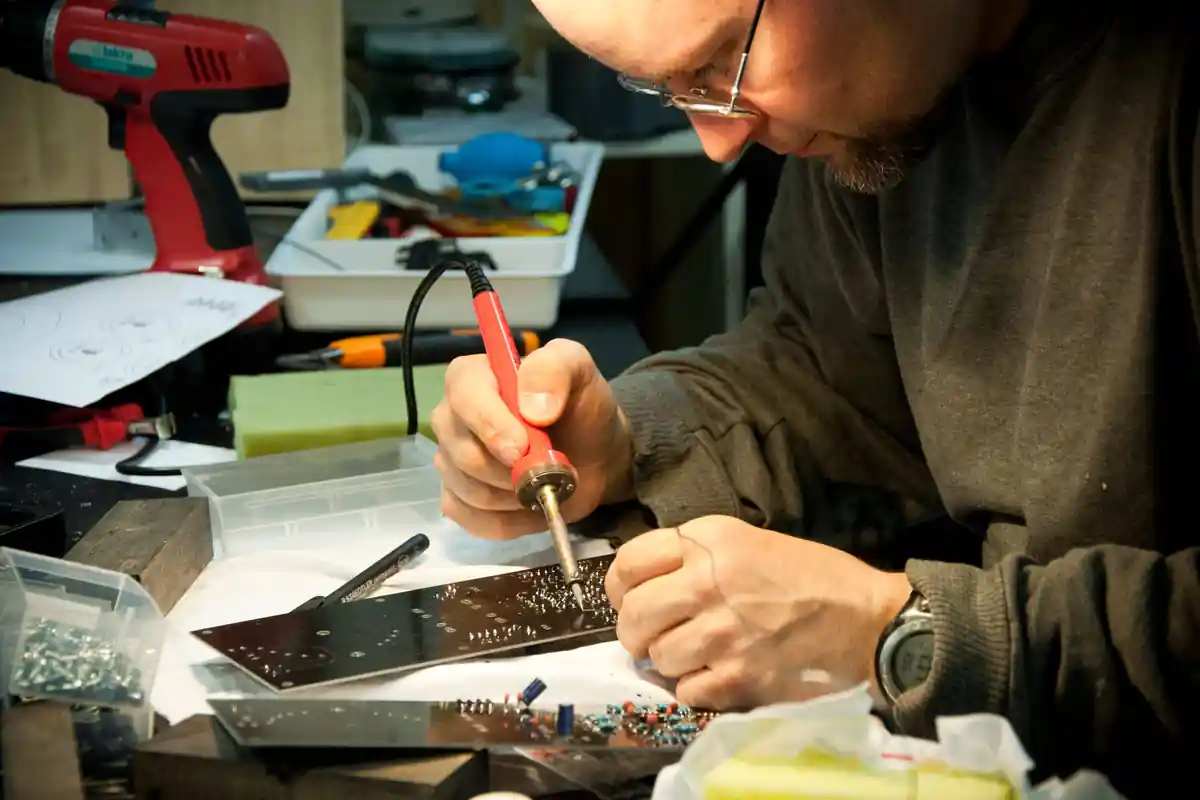
Electronics assembly requires the correct component, position and polarity as well as an acceptable solder connection. The assembler follows the bill of materials and work instructions when populating boards or building modules. Through-hole work differs from surface-mount assembly in placement, soldering and inspection. Specified ESD controls continue through handling, storage and transport between operations. Inspection looks for missing parts, incorrect orientation and connections outside the acceptance criteria. Rework follows a defined instruction: repeatedly applying heat without control can damage the board or component rather than improve an already doubtful connection.
What will you do?
- Check components, part numbers and the current work instruction.
- Fit electronic components and mechanical supports in the correct positions.
- Complete soldering or connection work when included in your training and role.
- Inspect products and perform assigned functional tests.
- Record defects and prepare approved products for the next stage.
Where will you work?
You usually work indoors at a prepared assembly station. Lighting, tidiness and protection of electronic parts are important. Product-specific arrangements may cover static electricity, cleanliness and the handling of tools and materials.
What does a working day look like?
After the handover, you check the order and components. You build the product in a defined sequence and inspect work along the way. Unexpected defects are discussed before continuing, helping prevent the same problem across a whole batch.
Which skills and experience help?
Fine motor skills, concentration and careful reading are useful. Soldering, inspection and experience with small components are valuable. Describe your product training and the assembly operations you can perform independently.
How can you develop?
Possible specialisms include inspection, testing, repair and assembly equipment. Product knowledge and consistent accuracy can support work on more complex batches or helping new colleagues learn the process.
Your practical experience
Use an example identifying the product, assembly technology and inspection you performed. Distinguish hand-soldered through-hole work, surface-mount rework and module assembly. Describe the ESD workstation, magnification and records for serial numbers or nonconformities, showing your actual contribution to product quality rather than only naming a production environment.
Practical questions about the trade
How does through-hole assembly differ from surface-mount assembly?
Through-hole component leads pass through holes in the board before being soldered. Surface-mount components attach to pads on its surface. This changes placement, soldering and inspection tasks, particularly for small packages. A board may use both technologies, so experience should identify the assembly, repair and inspection actually performed rather than simply stating that it involved electronics.
Why are ESD controls needed when a circuit board looks undamaged?
Electrostatic discharge can affect sensitive components without immediately visible damage. The established protection therefore covers handling, the workstation and appropriate packaging, including transfers between processes. Visual inspection does not replace prevention. Assemblers use the specified controls and report departures from them so that potentially affected product can be assessed under the organisation's quality process.
What can visual solder-joint inspection establish, and what can it not?
Visual inspection compares component placement, orientation and visible connections with the agreed acceptance criteria. It can reveal missing parts or visible joint defects, but cannot demonstrate every electrical function. The product therefore follows its specified combination of inspection and testing. Nonconformities are recorded, with rework performed under an approved method and followed by the appropriate reinspection.
More about this occupation
Occupational, training and technical sources relevant to this page.
- Neways — Elektronica-assemblage
- SBB / KiesMBO — Elektrotechnische installaties
- Assemblage Monteur Module Assembly - Neways
- Lutowanie przewlekane (THT) - Technika lutowania i wylutowywania elementów elektronicznych - zpe.gov.pl
- Lutowanie powierzchniowe (SMT) - Technika lutowania i wylutowywania elementów elektronicznych - zpe.gov.pl
- Exatronic - Vagas
- Montaż przewlekany THT - Technosystem Sp. z o.o.
- IPC-A-610 Endorsement Program | IPC Programs
- PCB Assembly | IPC-A-610 Class 2/3 and J-STD-001
- Ensuring Excellence: IPC-A-610